Wednesday, November 14, 2012

Plant Totems: Identifying Our Most Personal Herbal Ally by Jesse Wolf Hardin


Questions to ask yourself about potential Plant totems:


•Does it feel especially familiar, allied, relevant, related?
 
•Or significant, communicative, essential, momentous?
 
•Is there anything about its form, shape, color etc. that reminds you of yourself?
 
•Do you act on the world – or contribute to it – in any ways similar to how the observed plant does?
 
•Or do you respond similarly to stimuli, threat, reward, isolation, exposure, stress, nourishment or care?
 
•Has it been in your life for a long time, appearing again and again like someone seeking your attention?
 
•Or has it only fairly recently become significant in your life, but in a very dramatic, vital, extreme or timely way?
 
•Has it proven to be particularly potent medicine for a chronic ailment or imbalance of yours?
 
•Or has it been medicine for your emotional balance, helping you deal with especially difficult traumas or situations, to calm you enough to function or arouse you sufficiently to accomplish what needs to be accomplished?
 
•Do you find yourself thinking about it for no obvious or urgent reason?
 
•Or did it come to you in a vision, or appear to you in dreams?
 
•Does it feel like you have somehow dishonored or trivialized it, when you speak of it loosely, to those who may not care?
 
•When you have avoided it or ignored the thought of it for awhile, do you feel out of sorts, neglectful, unassisted or unmoored?
 
•Do you feel unreasonably relieved when reunited after a physical absence, or after a long period of not giving it any mind?
 

•Does it seem to ask anything of you, require response, point to a mission or calling, excite significant acts?

Click Here to Read Full Article...

How to make Lacto Fermented Garlic Dill Pickles


Today's homesteading activity is making Lacto-Fermented Kosher Dill Pickles!  So quick and easy to make and so healthy and delicious.  Goes great with just about anything...with any kind of burger or sandwich, cut up in a salad, as a snack, even with eggs in the morning.  Sometimes I will eat one just for the digestive enzymes after a heavy meal.  They are so yum!

These are some crazy weird new jars I got, long and thin, but they work great.  Pint and a half mason jars.  I got them by accident but they are actually really fun looking.  Anyway...Pickles!!!

Ingredients:
-Cucumbers:  As many that fit whole in the jar, or I also slice them in quarters.
-Sea Salt: I use about 1 1/2 teaspoons. You want the brine to taste salty but not overly salty.
-Dill (Dried or Fresh):  About 1 1/2 teaspoons.  I'm an eyeballer.  So any recipe you get from me, play with!  Just assess how much dill you want with your pickles!
-Raw Garlic: 2-3 cloves sliced
-Mustard Seeds: 1-2 teaspoons...Eyeball it! :)
-Filtered Water

Put cukes in jar.  Put the salt and spices in.  Fill with filtered water, cap well and shake to mix.  Let sit out at room temperature for 3-5 days, check them after 3 days and see if they are sufficiently pickley tasting!  Put in cold storage and enjoy!!!


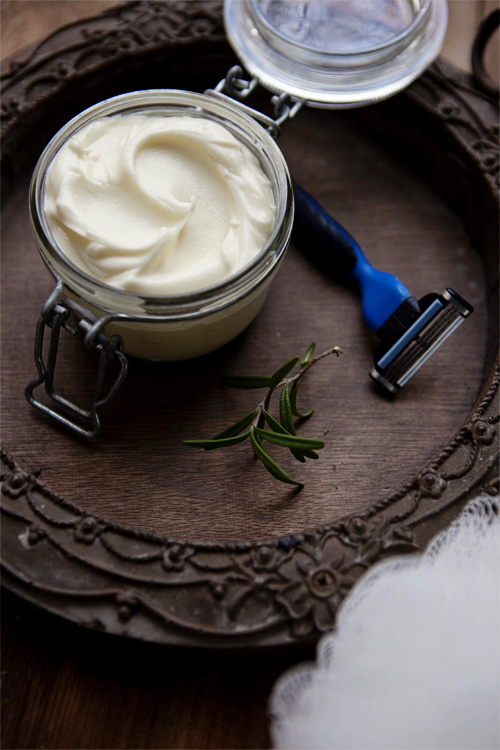
For the guys...Rosemary Mint Shaving Cream!


How to make homemade shaving cream with coconut oil and shea butter that smells like delicious rosemary mint... Click Here For Recipe and Instructions.


Tuesday, November 13, 2012

How to make Lacto Fermented Beets and Beet Kvass


Lacto-fermentation is a method of preserving vegetables. The process uses no fuel or preservatives, and allows vegetables to retain nearly all their nutritional value. Fermentation by natural lactic-acid-bacteria was used long before freezing and modern canning became standard food preservation methods. Vinegar has replaced lactic acid in most vegetable pickling processes. Before the advent of modern refrigeration and freezing, fermentation, drying or smoking were the primary methods of food storage and preservation. Asian, Indian and South Pacific cultures still utilize lactic-acid fermentation to preserve fruits and vegetables.

Fermented foods are those that have been overgrown by edible micro-organisms. These foods are pleasant tasting or nutritionally advantageous to humans. Lacto-fermentation involves converting the fermentable sugars in food to lactic acid by any of a number of "Lactobacillus" or related organisms. Diced or shredded vegetables are submerged in cool water, along with a quantity of sea salt or canning salt. The vegetables are held under the water by a weight of non-reactive material. Fermentation from naturally occurring bacteria takes place in this environment, leading to a bubbling, effervescent effect in the liquid surrounding the vegetables. The resulting product is kept in cool storage, and eaten in its raw, fermented state. 

Lacto-fermented beet products include a beet-juice beverage called kvass. Beets soaked in filtered or spring water and sea salt creates Kvass. (Some use whey but I skip it). The drink is sometimes touted as a beneficial morning drink. Lacto-fermented beet juice retains the active probiotic cultures of lactic-acid micro-organisms after several weeks in cold storage. -Excerpts from Livestrong Article

How to make Pickled Beets and Beet Kvass: 


Makes approx. 1 Quart
3 Medium Sized Beets 
1 1/2 tsp Himalayan or Real Salt
Filtered Water
Seeds from two Cardomom pods or three cloves (optional for beets but skip for kvass)
1/2 Medium Onion (optional for beets but skip for kvass)

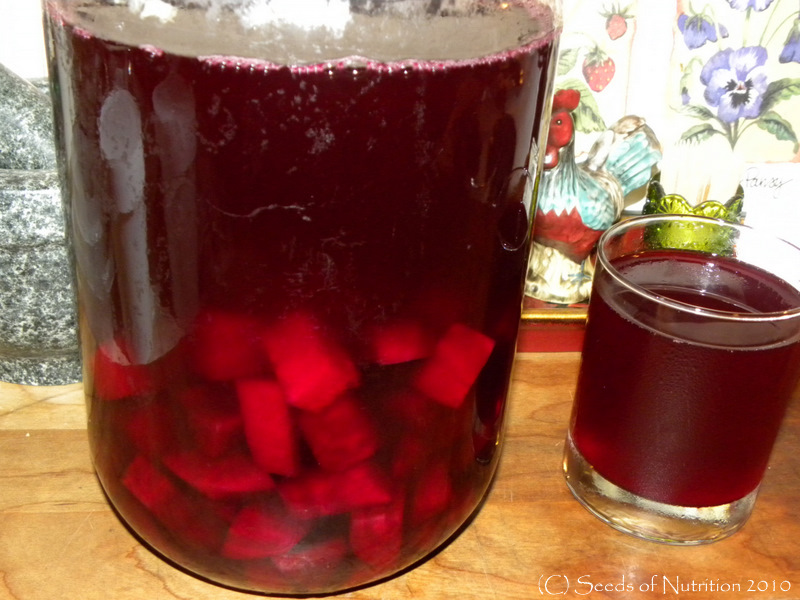
Chop the Beets (and onions if adding) into pieces as pictured above.  Place beets (and onions) into a well sterilized, wide mouthed, quart sized mason jar and press down lightly with a meat hammer or juicer pressure. Add salt (and spices if using) and fill jar with filtered water, enough to cover the beets.  The top of the beets should be at least 1 inch below the top of the jar.   Cover tightly and turn up and down several times to mix, then open and press the beets down again so they are below the water.  Cover tightly again and keep at room temperature for about 3 days before transferring to cold storage.  During the three day process if you notice the beets rising above the water open and press below water, and then close tightly again.

For Kvass, just remove the beets...and drink the liquid!  One four ounce glass, morning and night, is an excellent blood tonic, cleanses the liver, and is great for digestion and maintaining healthy intestinal flora. 

And here is a magical recipe I found for Citrus Ginger Beet Kvass! OMG.

Enjoy and have fun Lacto-fermenting!!!

Five Wild Foods That Are Hiding In Plain Sight


"I specifically asked John Kallas, director of Wild Food Adventures in Portland, for a list of wild foods that are often overlooked. I mean, I love chanterelles and blackberries, but I’d also like to branch out a little.

Kallas is the author of Edible Wild Plants: Wild Foods From Dirt To Plate. It’s the first volume in a series of wild food books he plans to publish. He’s spent decades studying wild foods and applying his Ph.D in nutrition to them. Now he teaches at wild food workshops and events.

And he had no shortage of suggestions for under-appreciated wild foods I should try. However, I was surprised to find that, well, they’re all weeds: Dandelions, goosefoot, garlic mustard, chickweed, and broad-leaf dock. They’re super nutritious, he said, and you can find them anywhere you find people.

“Other people might call them weeds,” he said. “I call these plants native to humans. They grow where we are. Weeds is a diminutive term, and a lot of these plants are better nutritionally than some of the domesticated ones. They’re right under our noses. They’re everywhere, and most people don’t even know about them. They grow in your garden. You’re probably weeding them out.”

Let’s take them one at a time..." Click Here to Read Full Article

Fukushima Updates...


Sky-high levels of radioactivity in fish from Fukushima means inedible seafood for at least a decade.


"Scientists were shocked to learn recently that levels of ionizing radiation in sea life living off the eastern coast of Japan are still exceptionally high following the devastating earthquake and tsunami that struck the region back in March 2011. And according to a new paper published in the journal Science, which draws on a myriad of data collected by the Japanese Ministry of Agriculture, Forestry and Fisheries (MAFF), the discovery could mean that seafood from Japan will be inedible for at least the next decade.
Since the disaster first occurred, researchers from Japan have been routinely catching and analyzing sample fish from the waters near the Fukushima Prefecture, which became tainted by radioactive runoff from damaged cooling pools and failed reactors following the disaster. The goal has been to continually test fish in the area to see whether or not levels of radioactive isotopes have fallen since the time earlier tests were conducted, which were verified at the time to be in excess of federal limits.
Much to the team’s surprise, radiation levels were found to still be about the same as they were before, indicating that either the Fukushima plant is still leaking radioactive materials, or that these radioactive materials have been accumulating at the ocean’s bottom, where fish continue to become exposed to them. In either case, cod, flounder, halibut, pollock, skate, sole, and various other bottom-feeding fish living in the area are likely unsafe for human consumption for at least the next ten years."  Read Full Article Here

Many massive pools of contaminated water are spread around Fukushima plant.  


“Water works well for this system since it has a very high capacity … and can be treated if it is contaminated,” said Angie Moore, associate professor of geology. “However, when there is a reactor accident like at the Fukushima, the systems that prevent nuclear contamination of the cooling water have failed and there is direct contact between the water and the radioactive material.” Read Full Article Here

6.0 magnitude earthquake strikes the southern coastline of Chile


A shallow 6.0 magnitude earthquake struck off the coast of Aisen, Chile at the shallow depth of 9.7 km (6.0 miles). No tsunami warnings were issued for the region, and there have been no reports of damage. The earthquake struck the southern coastline of Chile and the epicenter was 338 km (210 miles) W of Puerto Chacabuco, Chile. This is the fourth major earthquake to strike the planet in 48 hours. -TEP